How Laurence Jenkell Turned a Wrapped Candy Into a Monumental Sculpture
There are few objects on earth as universally disarming as a wrapped hard candy.
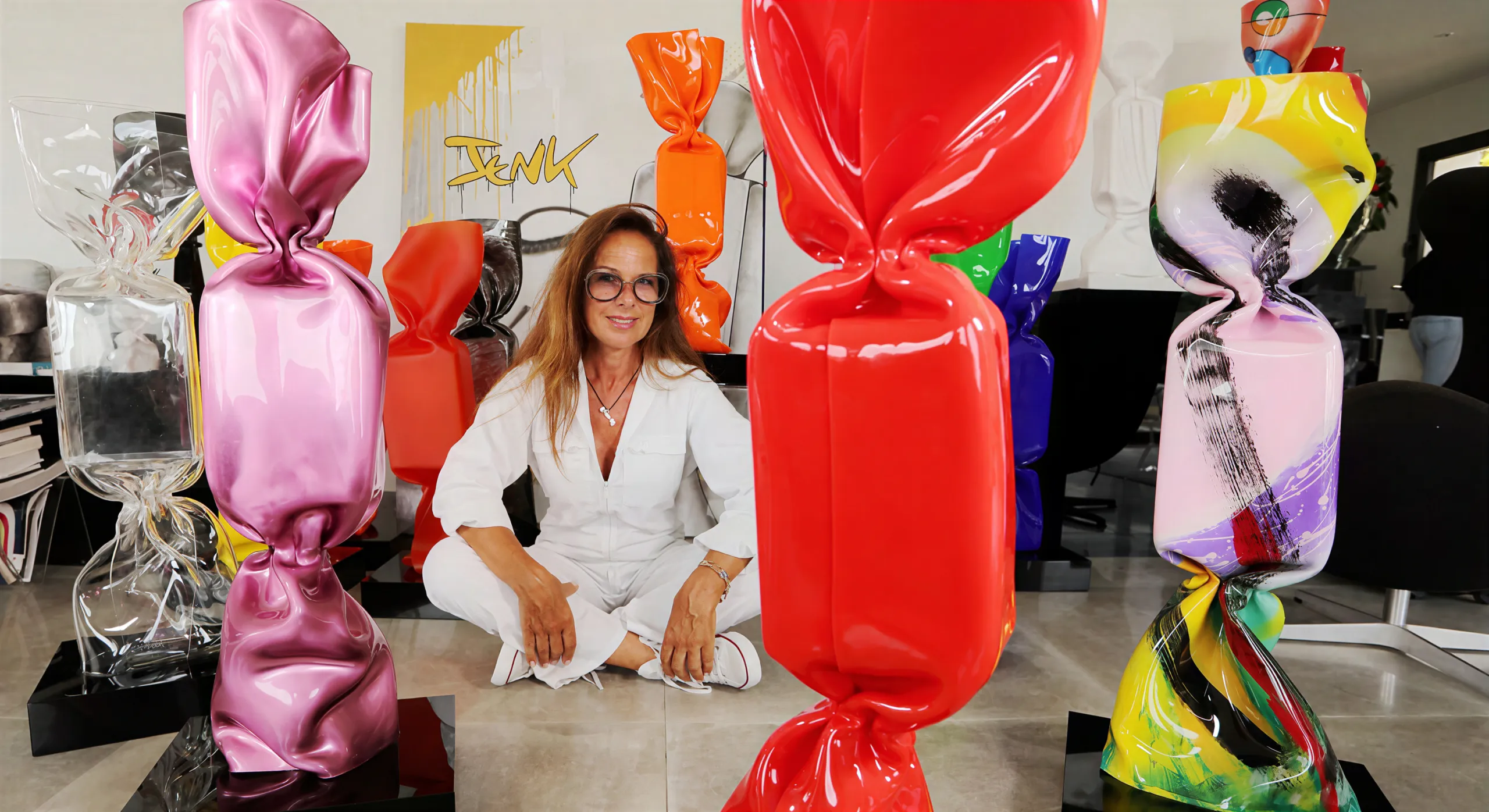
There are few objects on earth as universally disarming as a wrapped hard candy. It is a small, throwaway pleasure, a childhood currency of tenderness and bribery, unwrapped and forgotten in seconds. Laurence Jenkell has spent more than two decades taking that humble, fleeting thing and inflating it, literally and metaphorically, into a monumental signature of contemporary art. Her Wrapping Bonbon translates the sweet shop into bronze, marble, Murano glass, polyester resin and vivid plexiglass, standing nine feet tall on the plazas of Manhattan or set against the pale stone of the Côte d'Azur. The series has made JENK, as she signs her work, one of the most immediately recognizable names in contemporary sculpture.
A Childhood Without Candy
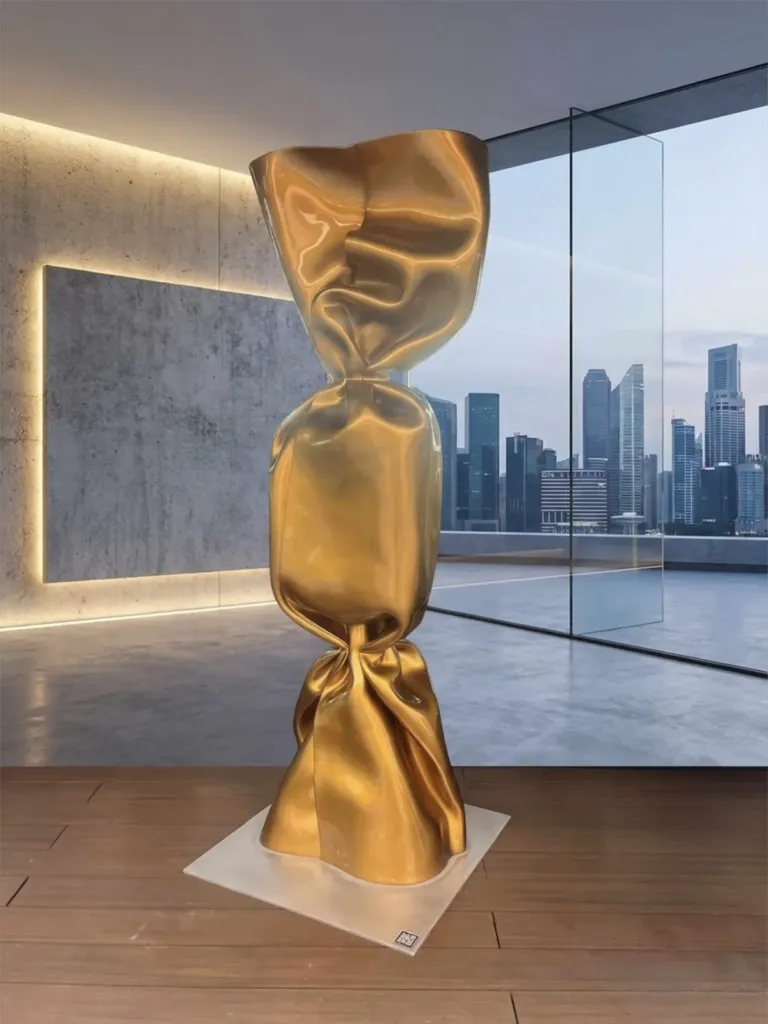
The origin story, appropriately enough, is one of sweet deprivation. Born on 31 December 1965 in Bourges, the artist was refused candy as a child. That small, ordinary frustration settled in her imagination and never left. It grew into a fascination with the candy as a symbol of sweetness, innocence and pleasure, and it eventually hardened into an entire artistic language. By the 1990s she was experimenting obsessively with materials, chasing a single motion: the twist. After numerous experiments she mastered the technique and created the iconic Candy sculpture, reproducing the torsion of material upon itself and the way a wrapper cinches at both ends at architectural scale.
That gesture, rolling the material back on itself with the twist of foil, is the engine of everything Jenkell has made since. It is deceptively simple, and it is everywhere. Across her collections the Bonbon is reworked in bronze, aluminum, marble, polyester, wood and Murano glass, each material bending her signature torsion toward a different temperament: the sacrificial weight of bronze, the liquid light of plexiglass, the cool permanence of polished stone. For nearly twenty years she has been sculpting brightly colored candies of different shapes and sizes, always returning to the same wrapped form.
Twenty Candies on Broadway
What elevates the work beyond pop-art nostalgia is scale and context, and Jenkell has a connoisseur's instinct for both. The definitive proof arrived in 2018 with Candy Nations, a spectacle that effectively commandeered a slice of Manhattan. From October 3 to December 9, twenty nine-foot-tall candies, each wrapped in the colors and geometry of a different national flag, were installed along Broadway in Manhattan’s Garment District, between 36th and 39th Streets. Each sculpture stood 2.7 meters tall and weighed roughly 658 kilograms. Together they turned a commuting corridor into an open-air gallery and a global capital into a candy box, drawing the eye of a city famously hard to impress.
The display carried a political genealogy. Candy Nations was originally commissioned for the 2011 G20 Summit in Cannes, where Jenkell installed 55 oversized, flag-wrapped candies representing G20 countries, invited nations and members of the European Union, shown in the very city where she now lives and works. It was a disarmingly elegant piece of soft diplomacy. National identity appeared in the wrappers of sweets, a reminder that even the grandest of nations can be unwrapped to reveal the same essential sweetness. The series remains among her most celebrated and widely publicized bodies of work.
The flags do more than decorate. They are how Jenkell keeps a single form perpetually fresh while giving it meaning. The Bonbon has appeared draped in the French tricolor along the Riviera, and in 2019 it took the colors of the Armenian flag, installed on the gilded stretch of Avenue George V in Paris for nearly a month. Each iteration is an act of translation, a universal candy container re-coded to speak to a specific people. It demonstrates that the Bonbon is less a fixed sculpture than a medium, a wrapping able to carry collective memory, globalization and desire from one setting to the next.
The wrapped candy is a promise that something sweet waits inside.
Beyond the Wrapper
That adaptability explains the longevity of her work. Her repertoire now stretches beyond the straightforward candy into aerial compositions with dynamic ramifications, sculptures built from expanding strips of color, compressed forms that expose the tension of the material, and graphic structures where line and volume hold a conversation with space. Through all of it, the torsion remains the anchor, a signature gesture that introduces dynamic tension and gives each work its singular sculptural presence.
Institutional France has taken note. Laurence Jenkell is a Chevalier of the Order of Arts and Letters, and on 8 September 2021, she received the insignia from Laurent Stefanini, the French Ambassador to Monaco, during a ceremony at Château de Crémat in Nice. It was official recognition of what the plazas and galleries had already understood: a self-taught sculptor from Bourges had built one of the most recognizable visual signatures in contemporary art.
Perhaps the most seductive quality of the Wrapping Bonbon is its generosity to the cities that host it. A Jenkell candy is an invitation. It reads in a single glance across any language barrier, pleases a child and a collector with equal speed, and photographs exquisitely, ideally in the morning light of the Riviera or the violet dusk of midtown Manhattan. It is public art that doubles as private luxury: the same twist that commands a plaza can be acquired as a bronze or plexiglass object for a collector's garden or salon. The critic Stéphane Corréard, in his text La vie dans les plis, reads the work as an exploration of the relationship between form, light and perception.
What Jenkell demonstrates, with her mountains of candy in Paris, New York and Cannes, is how fully scale can transform a familiar object. The wrapped candy is a promise that something sweet waits inside. Magnified to nine feet or cast in bronze, that promise becomes architecture, and the humble object becomes history. Laurence Jenkell simply refused, decades ago, to stop unwrapping that possibility, and the world's great boulevards are the sweeter for it.