Why the Jeff Koons Balloon Dog Remains a Modern Art Icon
There are trophies, and then there are trophies.
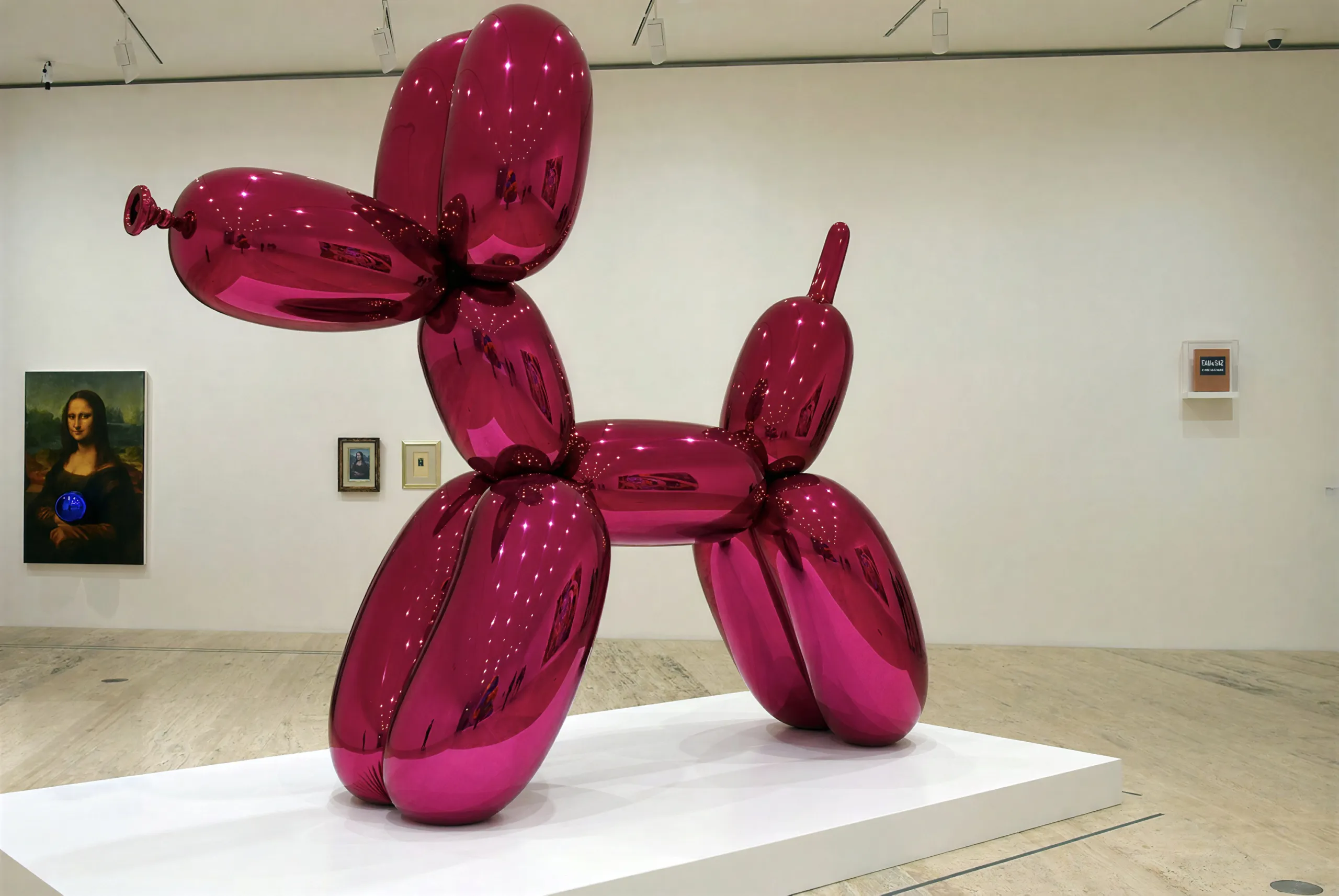
There are trophies, and then there are trophies. In November 2013, inside a Christie's New York salesroom, a ten-foot-tall rendering of the cheapest object imaginable, a twist-and-tie party balloon shaped like a dog, sold for $58.4 million, at the time the highest price ever paid at auction for a work by a living artist. The object was Jeff Koons's Balloon Dog (Orange), and in a single paddle raise it became the definitive emblem of twenty-first-century collecting: a child's birthday favor monumentalized into polished metal and priced like a blue-chip masterpiece.
Yet to call Balloon Dog a single sculpture is to miss the point. Between 1994 and 2000, Koons produced five unique monumental versions, Blue, Magenta, Yellow, Orange, and Red, each standing 10 feet 1 inch (3.07 meter) tall, nearly 12 feet (3.63 meters) wide, and 3 feet 9 inches (1.1 meters) deep, and each weighing several tons and each weighing approximately one ton.
We're balloons. You take a breath and you inhale, it's an optimism. You exhale, and it's kind of a symbol of death.
Jeff Koons
Mirror-Polished Steel
Even though they look so, the dogs are not rubber and air but mirror-polished stainless steel, cut, welded, ground, and buffed until the seams disappear and the surface behaves like liquid mercury. The color, crucially, is not paint. It is a transparent coating applied over the polished steel, so the hue seems to float above the reflection rather than sit on top of it. Every crease, every torque of the balloon's twisted ears and legs, had to be reproduced in a material engineered never to sag, to soften or to deflate.
That translation, from the ephemeral to the permanent, is the entire thesis of the work. Koons has explained that he has always loved balloon animals "because they're like us… We're balloons. You take a breath and you inhale, it's an optimism. You exhale, and it's kind of a symbol of death." The dog, then, is optimism cast in steel: a meditation on breath, on the buoyancy of life, held in a form that can never deflate. The artist has even suggested that the nose of the balloon reads as a navel, an umbilical cord, the very point where air, and life, entered.

For the collector's eye, the more seductive story is the object's construction. Each Balloon Dog is a feat of engineering masquerading as a cheap trick. The fabrication demands a small army of artisans working thousands of hours, coaxing rigid steel into the soft, inflated contours of a balloon. The result is an object of almost absurd presence: a form we have all held in our hands at a party, blown up to more than ten feet, rendered weightless in appearance and nearly immovable in fact.
Five Dogs, Five Owners
The five dogs now rank among the most rarefied private holdings on earth. Balloon Dog (Blue) resides with The Broad in Los Angeles; Balloon Dog (Yellow) belongs to the collector Steven A. Cohen; Balloon Dog (Magenta) is held by François Pinault; and Balloon Dog (Red) sits in the DESTE Foundation for Contemporary Art of Dakis Joannou. The orange (in the Mugrabi collection at this moment), of course, changed hands at auction, a record that has since been surpassed, but which still places the sculpture among the most expensive works ever sold by a living artist.
A $42,000 Accident
There is a delicious counterpoint in the work's afterlife. In February 2023, a visitor to the Art Wynwood fair in Miami tapped a 16-inch porcelain Balloon Dog, one of an edition of 799 produced in Limoges porcelain by the French house Bernardaud, and watched it topple and shatter on the floor. The moment went viral precisely because it inverted everything the monumental dogs promise. The steel editions cannot be deflated, cannot be popped, cannot be broken by an index finger. The porcelain edition could. It was a $42,000 reminder of the fragility the steel versions were built to defeat.
And yet the dog has also proven curiously democratic in its reach. It inspired a purchasable in-game sculpture called Yellow Dog with Cone in Grand Theft Auto Online and appeared in Spider-Man: Across the Spider-Verse during a scene set inside the Guggenheim, a wink Koons himself said left him “thrilled.” Few artworks of this price bracket are equally at home in a hedge-fund lobby, a contemporary art museum, a video game, and a superhero film. That is the work's genius: it collapses the distance between high and low, between childhood and mortality, between a ten-dollar party trick and a ten-figure asset class.
For the serious collector, Balloon Dog remains the essential Koons because it is his most complete statement. It is sculpture that performs its own impossibility: the most temporary of objects executed in the most permanent of materials, polished to a finish that flatters any room, any façade, any portfolio. It is, in the end, exactly what Koons intended it to be, like he said: “a breath, held forever.”