Fred Allard: The Alchemist of Luxury
How a self-taught artist from the Côte d'Azur turned handbags, sneakers, and Coca-Cola cans into monumental sculptures coveted by collectors from New York to Saint-Barthélemy.
There is a workshop just outside Nice where a former fashion entrepreneur spends his days compressing Chanel bags, Gucci handbags, and vintage Air Jordan sneakers into blocks of immaculately transparent resin. The man is Fred Allard, born in Nice on May 5, 1968, and what he practices is the art of freezing desire itself.
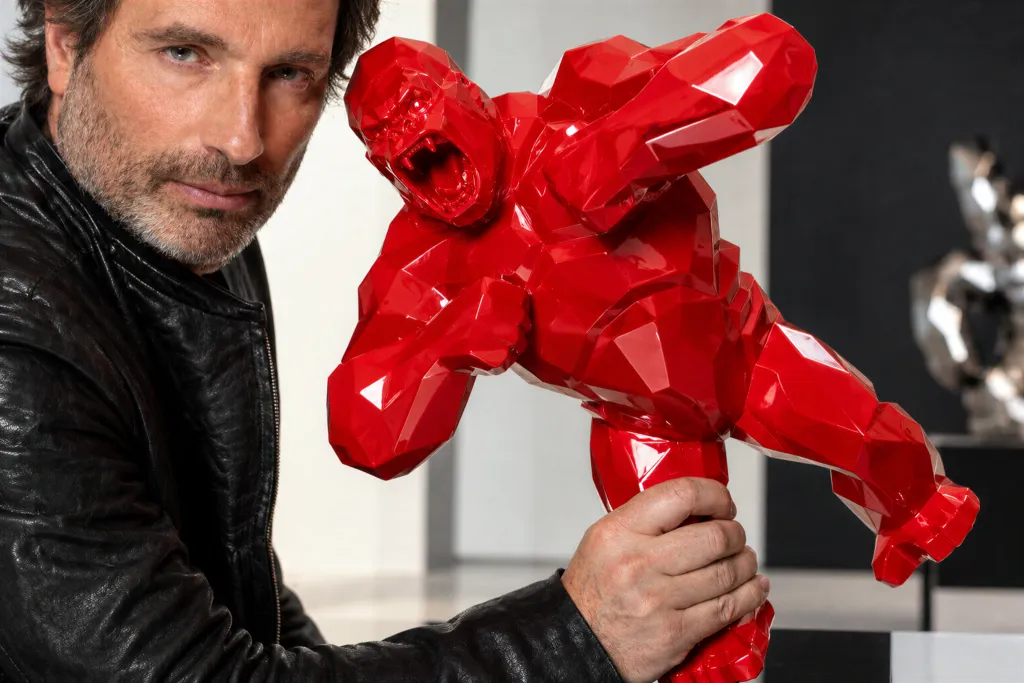
Allard is the latest heir to the celebrated École de Nice, the avant-garde movement forged in the 1950s and 1960s by artists who seized on everyday reality as raw material. His lineage is unmistakable. He works in the tradition of César, whose crushed automobiles scandalized the establishment, and Arman, whose inclusions and accumulations of found objects redefined what sculpture could be. Where his predecessors compressed cars and stacked violins, Allard compresses the totems of contemporary longing: the branded handbag, the limited-edition sneaker, the perfume bottle, the luxury suitcase.
He was nourished by their gestures, Allard says of César, Arman, and their peers, citing also the poster-torn aesthetics of Mimmo Rotella and Jacques Villeglé, and the pop vocabularies of Jeff Koons, Takashi Murakami, Damien Hirst, and Kaws.
The Accidental Portraitist
Allard's path to the atelier was unusually direct in motive and late in arrival. A self-taught visual artist, he first made his name in commerce. As a founder in women's ready-to-wear, he built the e-concept fashion store Vitrines Parisiennes in 2008. A personal reckoning at midlife changed everything.
"At the age of thirty I was already the father of three children," he recalls. "At 40, I wanted to create something that was mine." What followed was, in his own words, a long psychotherapy during which he emptied his bag, a phrase that became the title and philosophical core of his best-known work. A private process of self-examination became the aesthetic principle of an entire artistic career.
His first works were collages of sartorial magazine pages, torn and recombined. "I used what I had at hand," he explains, "giving life to my own obsessions: mounds of fashion magazines and packaging that I overconsumed, including Coca-Cola Light cans and luxury shopping bags." The leap his art took, from collage to the resin inclusion of whole handbags, was the point at which Allard found his signature: the technique of inclusion, compressing and crystallizing iconic objects of consumer society in translucent resin.
At 40, I wanted to create something that was mine.
Fred Allard
Frozen in Time
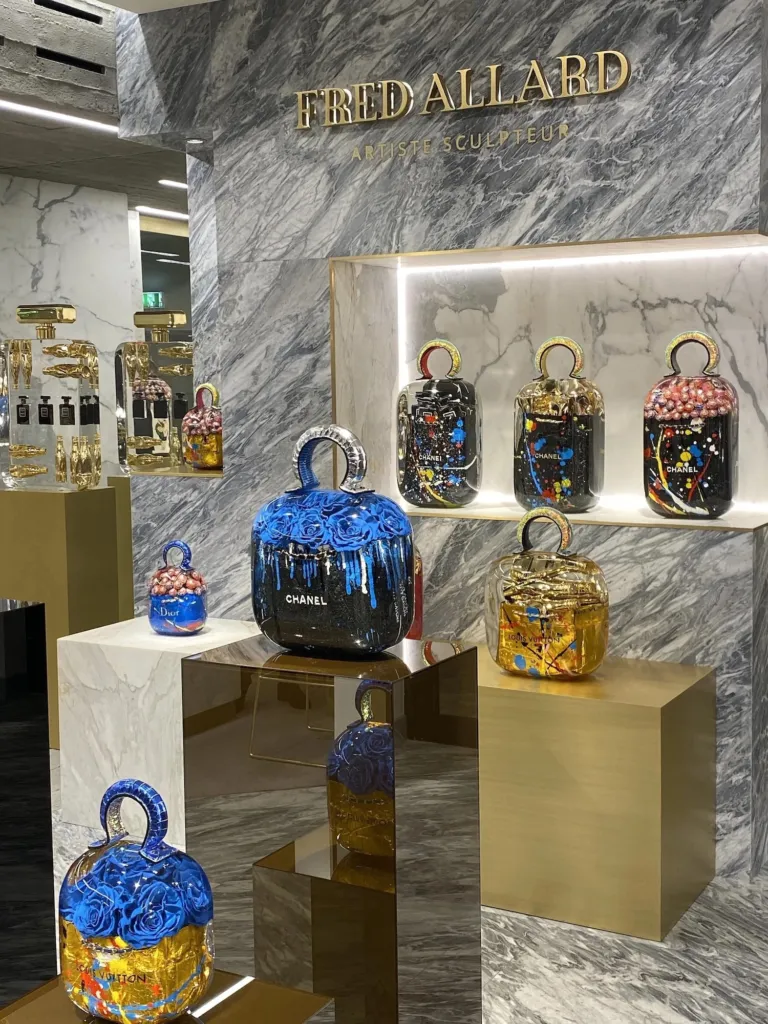
The result is a body of work that is instantly recognizable. On first glance, a Fred Allard is genuinely beautiful: a luxury paper bag frozen mid-crumple, its handles picked out in colored python; a roller bag whose contents, a basketball, a video-game controller, a sneaker, seem to float as if arrested at the moment of use. Look closer, and each piece performs a small act of observation on the world. By freezing these ephemeral objects in resin, Allard gives them an eternal existence, turning the disposable into what he calls real portraits.
His own taxonomy has grown precise. There are the Paper Bags, collapsed and recomposed; the Minaudières, petite evening clutches; the It Bags and Malettes; and the monumental Roller Bag and Travel Bag series. Each is a captured object, held for a long view.
That word, paradox, is the artist's center of gravity. "My sculptures Empty Your Bag are particularly symbolic," he says, "combining introspective gestures and show-offs, a major paradox in today's society." The works invite the collector to empty the contents of their own life into crystal. The contents of a bag are private; Allard makes them public, monumental.
The Clients Who Emptied Their Bags
The clients come. Allard counts among his commissions some of the most famous names in European sport: the Monegasque Formula 1 driver Charles Leclerc, the footballers Neymar and Raphaël Varane, the motorcycle world champion Fabio Quartararo, and the alpine skier Alexis Pinturault have each emptied their bags, selecting intimate personal objects to be sealed in resin. Neymar chose his cleats, his first headphones in Brazil's green-and-yellow, and his 2016 Olympic medal; Charles Leclerc chose the pair of scissors from his hairdresser mother and the pen with which his father signed his Ferrari contract. It is an autobiography worked in crystal.
The collaborations run deeper. In 2019, Allard's first New York exhibition, in SoHo over 3,000 square meters with more than 80 pieces, was dedicated to Karl Lagerfeld, the Kaiser of fashion. A monumental sculpture of the same name, The Kaiser, was created in collaboration with Jean-Roch, and featured a Bearbrick cast with Lagerfeld's own likeness, which the late couturier had validated back in 2018. His work has also intersected with Dior through collaborations and sculptures incorporating the house’s iconic objects.
The most direct commission on Allard's horizon sits on the Côte d'Azur's most storied cape. He has signed an exclusive collaboration with the Hôtel du Cap-Eden-Roc, the legendary clifftop retreat whose guestbook reads like the who's who of the twentieth century's brightest lights. Allard's capsule collection of more than twenty paintings and sculptures draws from that guestbook, Pablo Picasso, Charlie Chaplin, Elizabeth Taylor, Madonna, and from the lens of Slim Aarons, whose swimming pool portraits defined a genre. Allard has revisited that mythical history in canvases, Paper Bag sculptures, and a new Collectibles series, for which he moulds emblematic objects from the hotel itself into transparent resin. One of his works was auctioned in 2025 for the benefit of amfAR during the Cannes Film Festival.
A Family Man With a Mansion
For all his global reach, Allard's art is a family operation, and it sits entirely inside the Côte d'Azur. His workshop at Saint-Laurent-du-Var is run by his son Raphaël, whom he trained in a proprietary technique that took years of experimentation, and whom he acknowledges, with a smile, is now better than him. His daughter Estelle directs the gallery.
The venue he built reflects that domestic centre. In 2024, Allard opened an immersive 200-square-meter gallery on one of the most prestigious avenues in Nice, between two new five-star hotels, the Anantara Plaza and the Maison Albar. Designed with his daughter and the architecture firm Bleu Gris, it operates as a private mansion of staged rooms, books, and objects, with an intimate first floor for collectors, and a plan to replicate the workshop itself in the basement. He talks about a next dream: to empty the bag of the city of Nice in a monumental version.
Commercially, the enterprise is disciplined. Allard's pieces are sold in roughly thirty galleries worldwide: New York, Miami, Las Vegas, Aspen, and across Europe, the Middle East and Australia. Works are produced by hand and repeatedly available in limited series, priced between five thousand and one hundred thousand euros. He also releases collections of numbered works at accessible prices, between three hundred and fifteen hundred euros, opening his work to a wider audience.
His own summary is a phrase that suits the work: luxury, caught in the act.
Fred Allard has built an international reputation by doing what the École de Nice once did, making the realities of consumption beautiful enough to be examined directly. For the practical, there is a fact worth remembering: each piece, by turns a portrait and a habitat, a trap and a trophy. The Kaiser, it turns out, has already signed his share.