From Kong to Courchevel: The Art of Richard Orlinski
In Courchevel 1850, the most rarefied village in the French Alps, the art world's most bankable beast has become as much a signature as the snow itself.
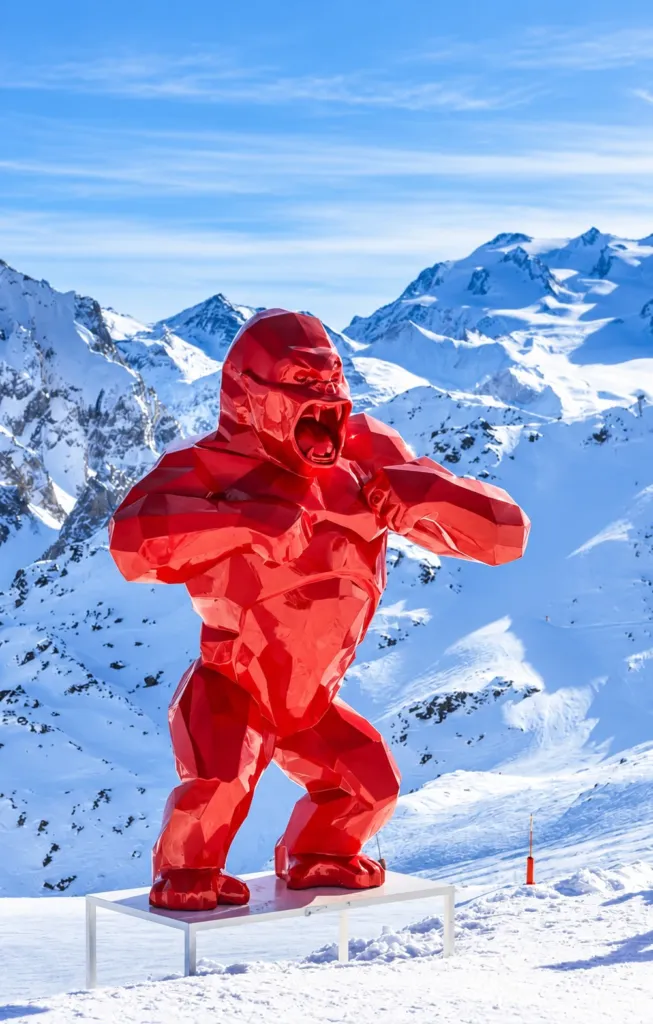
On a crystalline February afternoon in Courchevel 1850, the light does peculiar things. It skids off the glacier-polished roofs and glints against the plate glass of the luxury maisons along the Croisette. And in more than one widely photographed winter, it has struck a monumental gorilla planted in the snow high above the resort: at the top of the Saulire cable car, around 2,700 metres, a colossal red Wild Kong has greeted skiers at the end of the run, while in other seasons a blue resin "Kong Penseur" has sat in its hunched, thinker's pose on the same slopes. The work is a Wild Kong by Richard Orlinski, and it has become as much a fixture of the highest of the resort's six villages as the private aircraft banking into the altiport and the fur coats gliding into Cheval Blanc.
If you want to understand the art market of the past decade, its convergence with luxury, travel and pure spectacle, this is the image to hold: a faceted animal, engineered like a supercar, planted between the ski area's cable cars and the five-star chalets below.
Born Wild
Orlinski is among the most commercially formidable French sculptors of his generation. He was born in Paris in 1966, studied management at Paris 1–Sorbonne, and built a successful career in real estate before a burnout in 2004 pushed him to devote himself full-time to art. He began sculpting in earnest in the early 2000s and built what he calls Born Wild, a bestiary of instinctive, untameable creatures reduced to hard, diamond-cut planes.
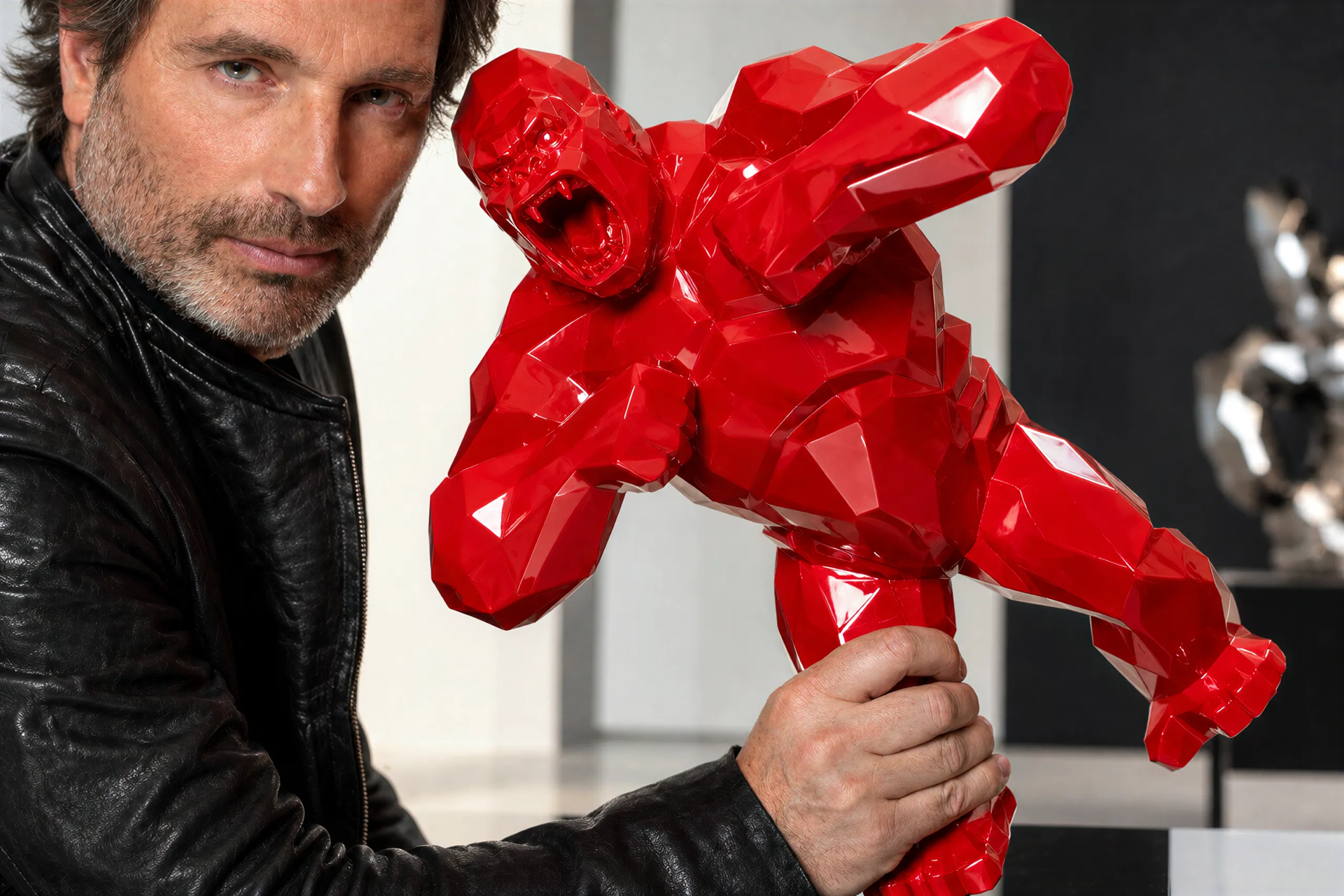
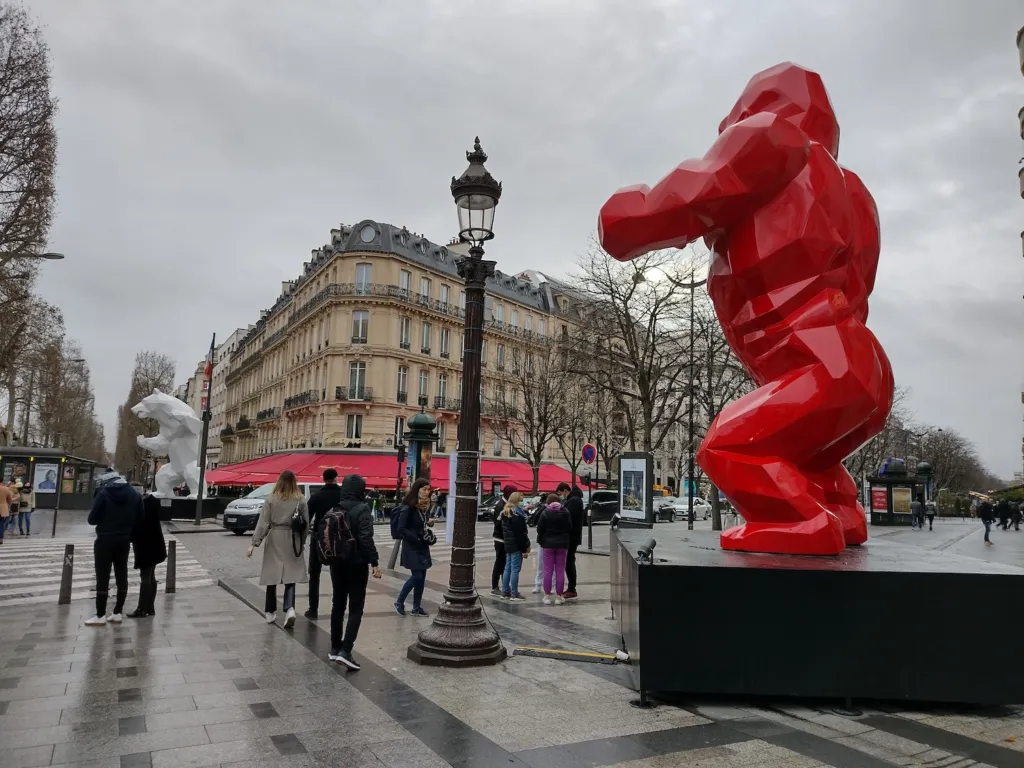
The gesture was simple and devastatingly effective: take the wildest things on earth and trap them in geometry. His King Kong, the Wild Kong, is the emblem. The work is widely understood as a tribute to the great screen gorilla, but Orlinski's ape is no movie monster; it is a silverback of pure surface tension, all angles and edges, as if nature had been passed through an algorithm.
The faceting (the process of cutting and polishing flat surfaces) reads like a stealth fighter; the posture suggests something older and more dangerous. He has produced it in sizes from a desk-sized edition to monumental works several metres tall, in colours that run from Ferrari red to acid yellow and mirror chrome, including the luminous blue associated with the "thinking" version that has appeared high above Courchevel.
Where Kong broods, the Lion prowls. Orlinski's lion is a study in a different kind of power: muscle and sovereignty. Rendered in the same crystalline language, his Lion reads less like a zoo animal than a heraldic device for the modern age, which is precisely why it has ended up in private collections and public installations where the word "king" still carries weight. It is a sculpture for people who feel like kings in their kingdom.
The distance between a statue and a sculpture matters here. A statue commemorates; it is civic, static and dutiful. Orlinski's sculpture refuses duty. These are objects of engineered appetite, of instinct disciplined into form. They are voraciously acquired, by collectors from Paris to Palm Beach, from Doha to Gstaad.
Kongs at the Castle Gates
His most poetically surreal staging came in Carcassonne, the medieval city in Occitanie whose fortified cité is a UNESCO World Heritage site. In the summer of 2025, the city scattered five of his monumental sculptures through its emblematic spaces, from the squares and gateways of the lower Bastide, such as the square Gambetta, the square André-Chénier and the Portail des Jacobins, to the edge of the medieval cité itself. Purists flinched, but everyone else reached for a camera. The effect was conversation: medieval masonry and twenty-first-century polymer: both obsessed with defence and display, both built to last.
That exhibition did what Orlinski always does. It democratised and monetised at once. Families queued beneath the battlements; collectors arrived separately, by arrangement. For an artist routinely ranked by Artprice among the best-selling contemporary French creators, the two audiences are not contradictory.
Editions, Bronzes and a Hublot
The economics of the Orlinski universe are precisely calibrated. Editions in smooth resin begin within reach of a serious enthusiast; monumental bronzes, polished aluminium and carved marble escalate into six figures and beyond. His collaborations read like a checklist of the luxury sector's most disciplined houses, most famously Hublot, whose Classic Fusion Orlinski watches replicate the faceting of his sculptures on the bezel and case.
And then there is Courchevel, which understands him better than any museum. The resort has made Orlinski installations part of its winter scenography in recent seasons, placing faceted animals on the mountain with the confidence of a town that knows its clientele has seen everything. A Kong planted on the snowfields above the village is furniture for the ultra-wealthy, a photograph made with the brightest new iPhones waiting to happen between two runs.
It is a sculpture for people who feel like kings in their kingdom.
What Orlinski grasped early is that contemporary luxury wants to be recognisable at a distance, shareable in an instant, and heavy with symbolic wildlife, dominance, freedom.
So the next time the snow falls over Courchevel 1850 and a helicopter thuds low toward the altiport, look for the gorilla on the slopes above.