David Yarrow and the Art of Fearlessness
David Yarrow turned the art market’s most dangerous subject into its most luxury object. Behind every print is a wager on patience, proximity… and an animal that has never once signed a release.
It is the one picture in the room that gets all the attention the moment guests arrive at your house or office. Imagine somewhere on your wall hangs an eight-foot expanse of black-and-white: a wolf mid-stride behind a saloon bar, or a lion emerging from shadow. All the attention immediately goes to that image. That is the quiet accomplishment of Yarrow photography, a practice that stopped being wildlife photography years ago and became something closer to luxury portraiture, one whose subjects weigh four hundred pounds.
A Banker With a Camera
The man behind it was truly built for this odd vocation. David Yarrow grew up in Glasgow, Scotland, talked his way onto the pitch of the 1986 World Cup final to shoot for a London paper, then spent years on trading floors in the City. He eventually left finance for good and went to Africa with a camera, chasing the one subject that had always interested him more than any market: the wild animal. Give a lion a path it already wants to take and patience does the rest.
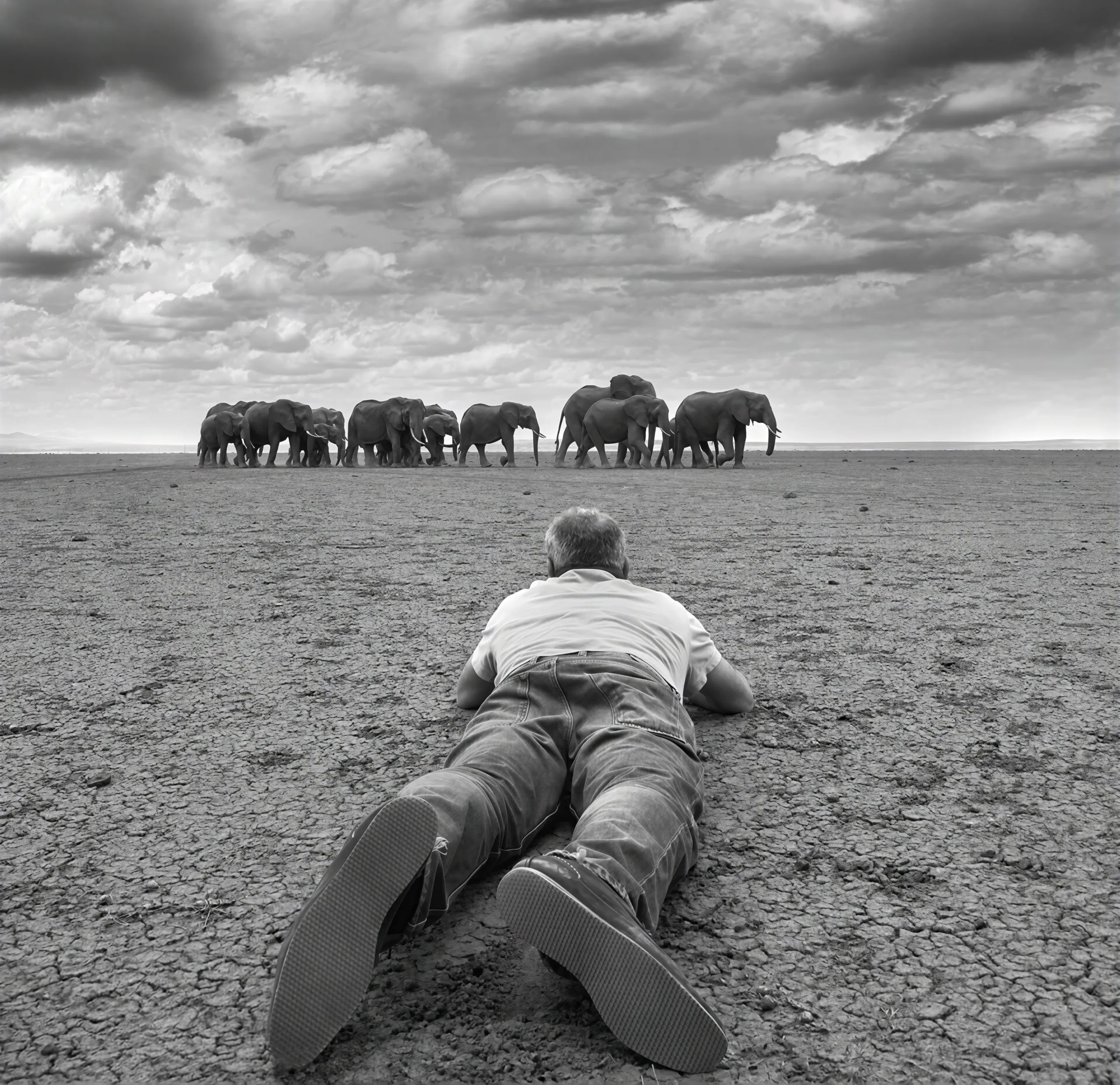
His method is the opposite of every cliché about the long lens and its cowardly distance. Yarrow works wide-angle and close, the camera set inches off the ground, sometimes using a hard flash fired remotely from a trigger in his palm. He puts the lens where his intuition tells him where the animal will be. The angle turns a wolf into architecture. The flash turns fur into lacquer. The monochrome strips away the postcard and leaves something that looks less like a nature photograph and more like a formal portrait of an aristocrat who has just decided not to eat you.
A Wolf at the Bar
"The Wolf of Main Street," the image that remains his calling card, is really a one-act play. A grey wolf pads along the counter of the Pioneer Bar in Virginia City, Montana, while the barman pulls beers, a customer reads the newspaper and a pool player continues his game. No one looks up. Everyone was instructed not to. The scene was staged spontaneously inside a real Wild West saloon, allowing the predator to pass through it like a rumour. Seven years later Yarrow did it again with a lion in The Lion's Den, raising the stakes the way sequels do: a bigger star, a tighter budget, and the same nerve-shredding question of whether the animal would hit its mark. And it did. The image finds a fully grown male lion walking on the bar towards the camera as if he is walking towards you, the effect is intense and powerful.
That sense of controlled danger is the engine of the whole enterprise. It powered Yarrow’s extended Wild West series, for which he photographed Cindy Crawford and Cara Delevingne in Montana beside the very predators that once made the frontier dangerous, all of it rendered in the hard monochrome that has become his signature. It is fashion work with fangs, and it hints at why collectors respond the way they do. A Yarrow print is evidence of a risk that someone took on the buyer’s behalf, a taxidermy of nerve.
The angle turns a wolf into architecture. The flash turns fur into lacquer.
Editions of Twelve
The market has been built with the same precision as the shoots. Yarrow prints are released in strict editions, typically of twelve, with artist proofs, and leave the gallery signed, numbered, framed, glazed, and documented, perhaps even the same way a complicated Patek Philippe leaves the store. The large formats run to nearly eight feet wide and are made for the double-height rooms of mansions, villas and penthouses. Galleries such as Maddox, one of the most famous fine art dealers in the world based in London, has moved its strongest editions before the framing is even ordered.
The prices would be harder to look at if the money simply stopped. It does not. Since 2018, Yarrow's work has raised more than twenty million dollars for conservation and philanthropic causes. It is a neat and slightly unusual alignment: the same man who packages wildness for the ultra-wealthy signs the cheque that protects the wildness he photographed. Not everyone is moved by big cats on gallery walls, but most people can admire a system in which the sale of a lion picture funds the survival of actual lions.
For everyone who will never own the eight-foot edition, there is the book. The definitive Yarrow coffee table book, an oversized monograph gathering decades of work, lives on tables between the property magazines and the single malt, doing the work of a catalogue and a trophy all at once. It is the cheapest way into the world, and for a great many collectors it is also the gateway drug.
Yarrow is in his sixties now and still takes the pictures himself, which is rarer in his market than it should be. He spends his winters far from any road, standing beside a remote camera, reading tracks and waiting for an animal to keep an appointment it never agreed to. Sometimes the animals arrive; sometimes days or weeks of work produce nothing, but they invariably arrive. The photographs that follow are proof that the most profitable thing in contemporary photography is the nerve to stand close enough to take it.